 avarek2023WP
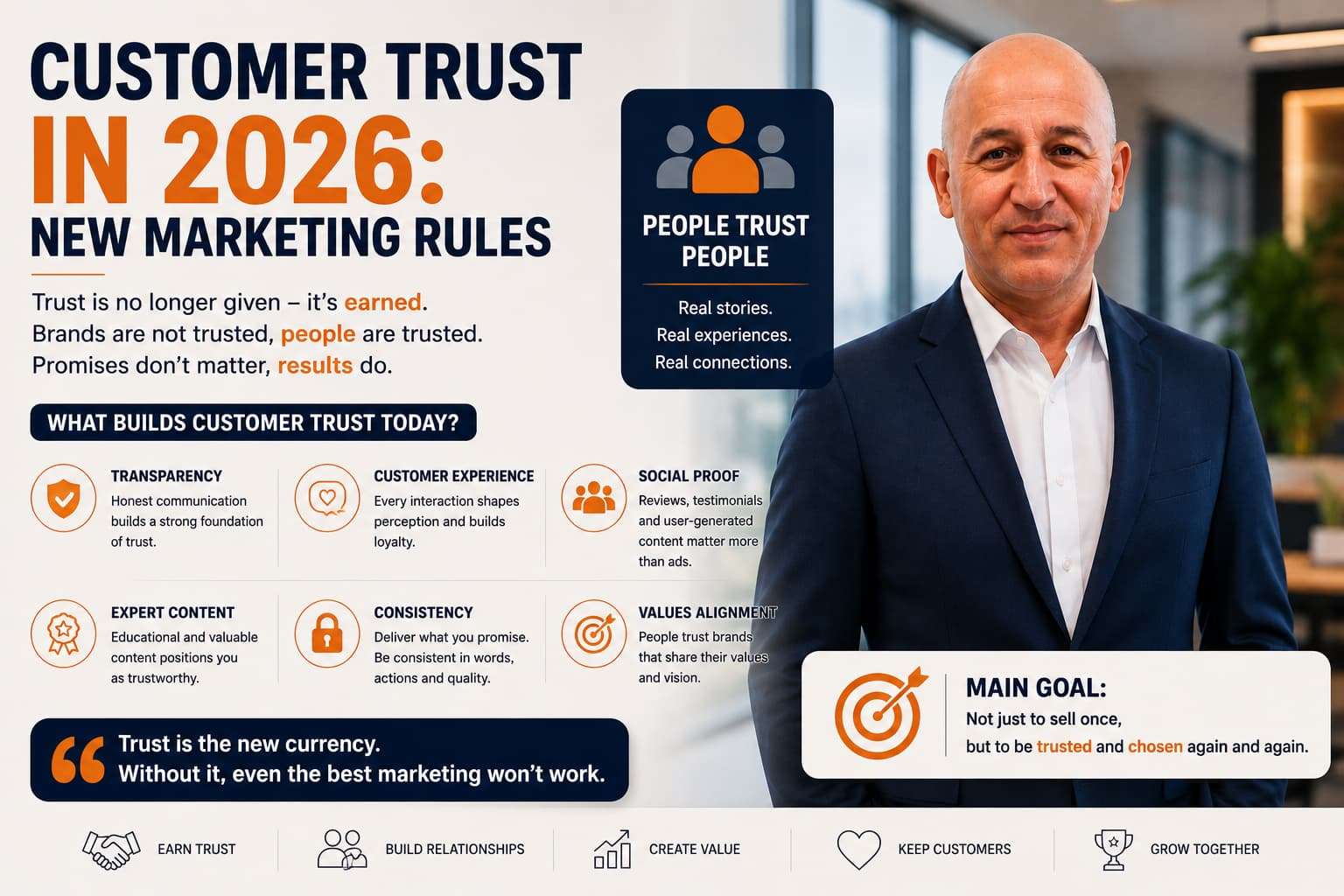
Customer Trust in 2026: Why Trust Has Become the Main Resource of Business
Lately, I’ve been thinking a lot about what’s happening with customer trust in 2026.
The more I observe the market, business, customers, and my own behavior, the clearer one thing becomes:
trust has become one of the most scarce resources in modern business.
And this directly affects marketing, sales, reputation, and customer loyalty.
In the past, in many niches, it was enough to create a beautiful website, launch an ad, gather a few good reviews, and place a polite manager in the sales department.
Today, that’s no longer enough.
Why Has Customer Trust Become Harder to Earn?
Customers are tired.
Tired of identical ads.
Tired of phrases like:
“We are the best on the market.”
“Special offer only today.”
“Thousands of customers trust us.”
“Individual approach to each client.”
Tired of content that looks perfect but doesn’t feel real at all.
Especially now, when artificial intelligence and neural networks allow almost any business to create a beautiful text, image, ad creative, or even video in just a few minutes.
As a result, the amount of content grows, while the value of each individual message decreases.
And a paradox arises:
the more perfect content around, the more people seek real people.
The client wants to understand:
Who is behind the company?
To whom am I giving my money?
Can these people be trusted?
What will happen if a problem arises?
Will they respond to me after payment?
And does what is promised in the ad really match reality?
In 2026, Customers Trust Not Only Brands
In my opinion, a very interesting shift is happening.
People increasingly trust not an abstract company, but specific people within that company.
The founder.
The expert.
The manager.
The doctor.
The consultant.
The salesperson.
The person who appears on camera and speaks on their behalf.
That’s why personal branding, expert content, and human communication are becoming increasingly important marketing tools.
When an entrepreneur is not afraid to show their face, talk about the process, explain their decision, or admit a mistake, it creates a completely different level of communication.
Because behind the brand, there is a person.
And it’s easier to trust a person than a faceless organization.
Trust in Business Is Built Not on Promises, but on Consistency
I am increasingly convinced that customer trust cannot be built with a single advertising campaign.
It is formed gradually.
Today you promise one thing.
Tomorrow the client sees that you actually do it.
A month later, they receive the same level of service.
A problem arises — and you don’t disappear.
The client writes to you after the purchase — and gets a response.
It is from such small actions that the company’s reputation is gradually formed.
Therefore, trust is not a separate marketing tool.
It is the result of how well the business’s words match its actions.
Promised → Delivered.
Mistake → Admitted.
Problem arose → Solved.
Can’t fulfill → Honestly said.
In my opinion, this consistency is becoming one of the main competitive advantages today.
The Client Evaluates the Entire Customer Journey
Another important trend I see in 2026:
trust is formed not at the moment of sale, but throughout the customer’s journey.
A person may first see your ad on Instagram or Google.
Then go to the website.
Check social media.
Read reviews.
Study cases.
Watch videos with employees.
Write to a manager.
Compare you with competitors.
Pay.
Receive the product or service.
And then contact support.
And each of these touchpoints either increases trust or destroys it.
For example, a company can spend a huge budget on advertising but lose a client because the manager responds after several hours.
Or create an excellent website, but after payment, the client encounters a completely different level of service.
Or gather hundreds of positive reviews but not respond to negative ones, thereby creating the impression that the company is trying to hide problems.
Therefore, today I would look not only at the sales funnel but also at the trust funnel.
What Builds Customer Trust in 2026?
For me today, it is primarily:
1. Transparency
The client doesn’t need to create the illusion of a perfect business. It’s much more important to honestly show how everything works.
2. Real Reviews
Not just beautiful quotes on the site, but real customer stories, cases, results, and interaction experiences.
3. Human Communication
Not every response should sound like it was written by a corporate bot.
4. Expertise
Useful content that truly helps a person understand the problem works for trust much stronger than constant advertising messages.
5. Consistency
If today the company says one thing, tomorrow another, and the manager promises a third — trust disappears.
6. Reputation
The client looks not only at what the company says about itself but also at what others say about it.
7. Post-Sale Service
Very often, the true level of business becomes clear only after the client has already paid.
And Here Another Important Problem Arises — Trust in Information
Today, the client may not limit themselves to searching for reviews.
They can ask ChatGPT, Gemini, Claude, Perplexity, or Google AI which company to choose, which product is better, or whom to trust.
This means that it is no longer enough for a business to just look good in advertising.
It needs to build a digital reputation and brand information presence on the internet.
Because in the future, the question will increasingly be not only:
“What does the company say about itself?”
But also:
“What does the internet as a whole say about this company?”
And this is already a completely different level of marketing.
The Main Challenge of Business in 2026
It seems to me that the main challenge of this year is not just to convince a person to make a purchase.
That’s too short a goal.
It’s much more important to make sure that after the purchase, the client thinks:
“I’m glad I chose them.”
And even better — that in a few months they return on their own.
And recommend you to another person.
Because the true value of trust manifests itself right here.
Advertising can bring the first client.
Trust brings the next ones.
And that’s why I’m increasingly convinced: in 2026, marketing is not only about reach, clicks, leads, and sales.
It’s also about reputation, the human face of the business, the quality of the customer experience, and the alignment of promises with reality.
Personally, I’ve decided to focus on this.
On transparency.
On live communication.
On expertise.
On real results.
And most importantly — on ensuring that my word is no different from my deed.
Because in a world where content is becoming easier to create, sincerity, consistency, and real evidence are becoming more valuable.
And how do you feel about it yourself?
Is it easier or harder to trust companies today?