 avarek2023WP
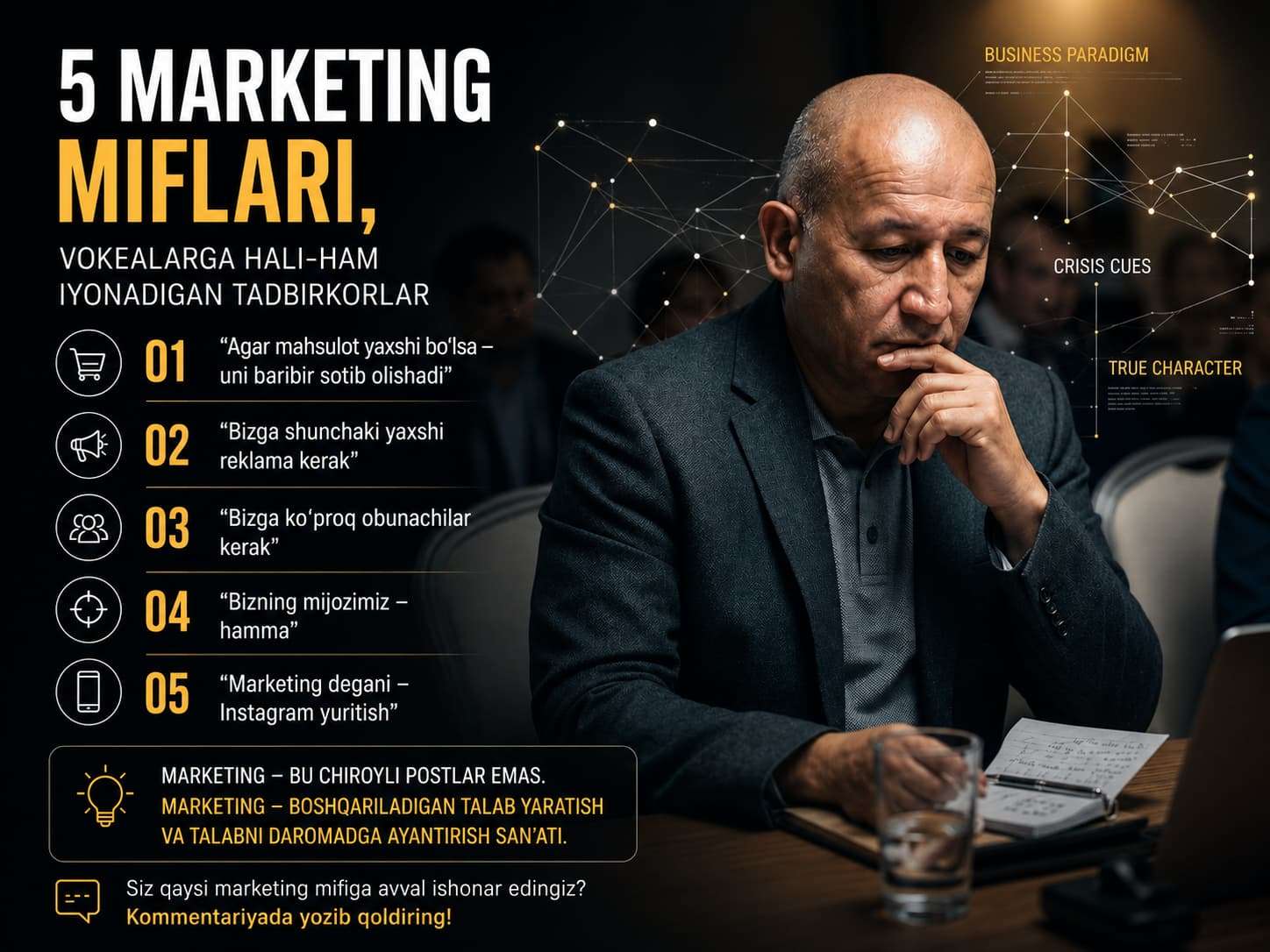
5 Marketing Myths Entrepreneurs Still Believe In
Marketing is not just advertising, Instagram, or beautiful publications. Misconceptions about marketing can cost a business much more than an unsuccessful advertising campaign.
Entrepreneurs often look for new promotion tools, increase the advertising budget, hire SMM specialists, and launch more content. But if the marketing strategy is built incorrectly, additional investments will not necessarily lead to increased sales.
Let’s analyze 5 popular marketing myths that hinder business development.
1. “If the product is good, it will sell itself”
This is one of the most common myths in marketing.
A quality product by itself does not guarantee sales. A potential customer must:
- learn about the product;
- understand what problem it solves;
- see its value;
- understand the difference from competitors;
- have a reason to make a purchase right now.
Therefore, product quality and marketing work together.
Even a really good product can go unnoticed if the company has weak positioning, an unclear value proposition, or incorrect communication with the target audience.
A good product is the foundation. But marketing helps make it understandable and in demand in the market.
2. “We just need good advertising”
Advertising is only one of the marketing tools.
If the company’s offer is weak, the target audience is incorrectly defined, and the client does not understand the product’s value, increasing the advertising budget will not solve the problem.
Before launching advertising, it is necessary to answer several questions:
- Who is our client?
- What problem do they want to solve?
- What prevents them from buying?
- Why should they choose us?
- How does our offer differ from competitors?
- What value does the client receive?
- What path does a person take from first contact to purchase?
Advertising enhances the existing marketing system. It does not replace the strategy.
3. “We need more followers”
The number of followers is far from the main indicator of marketing effectiveness.
For a business, the quality of the audience and its ability to turn into clients is much more important.
For example, an audience of several thousand potential buyers can be significantly more valuable than tens or hundreds of thousands of random followers.
Therefore, when evaluating SMM and digital marketing, it is necessary to look not only at reach and the number of followers but also at:
- the number of inquiries;
- the number of potential clients;
- conversion;
- customer acquisition cost;
- average check;
- repeat purchases;
- profit;
- return on marketing investment.
The goal of marketing is not to gather as many followers as possible. The goal is to attract the right audience and turn attention into sales.
4. “Our client is everyone”
If an entrepreneur says: “Our product suits everyone”, it often means that the target audience has not been sufficiently studied yet.
Different groups of clients have different:
- needs;
- motivation;
- financial capabilities;
- selection criteria;
- fears and objections;
- reasons for purchase;
- decision-making process.
Therefore, defining the target audience is one of the key tasks of a marketing strategy.
The more accurately a business understands its client, the easier it is to create the right offer, advertising message, and content.
Marketing becomes stronger when the company speaks not to everyone, but to a specific person and their specific problem.
5. “Marketing is running Instagram”
Instagram, Telegram, TikTok, YouTube, search advertising, SEO, and other channels are marketing tools, not marketing itself.
A full-fledged marketing strategy can include:
market analysis → target audience research → positioning → value proposition → choice of promotion channels → advertising strategy → content → sales funnel → conversion → customer retention.
Therefore, regular posting does not mean the business has marketing.
You can publish content every day and still not understand:
for whom we are doing this, why, and what business result we should achieve.
What is marketing really?
Marketing is not just advertising, SMM, and content creation.
Marketing is a system of understanding the market and the client, creating value, generating demand, and turning that demand into sales and long-term customer relationships.
That is why the right question for an entrepreneur is not:
“What advertisement should we launch?”
But:
“What business task do we want to solve with marketing?”
For example:
- increase sales;
- attract new clients;
- enter a new market;
- increase the average check;
- increase brand awareness;
- increase the number of repeat purchases;
- reduce customer acquisition cost;
- increase conversion;
- create a sustainable flow of applications.
And only after defining the task should you choose marketing tools.
The Main Mistake of Entrepreneurs
The most expensive mistake is mistaking a marketing tool for a marketing strategy.
Instagram is a tool.
Advertising is a tool.
SEO is a tool.
Content is a tool.
Telegram is a tool.
Strategy begins with understanding the market, the client, the product, and business goals.
If this is not in place, increasing the advertising budget may simply increase expenses.
If marketing is built as a system, each channel works not by itself, but to achieve a specific business result.
Which marketing myth did you previously believe in? Write in the comments