 avarek2023WP
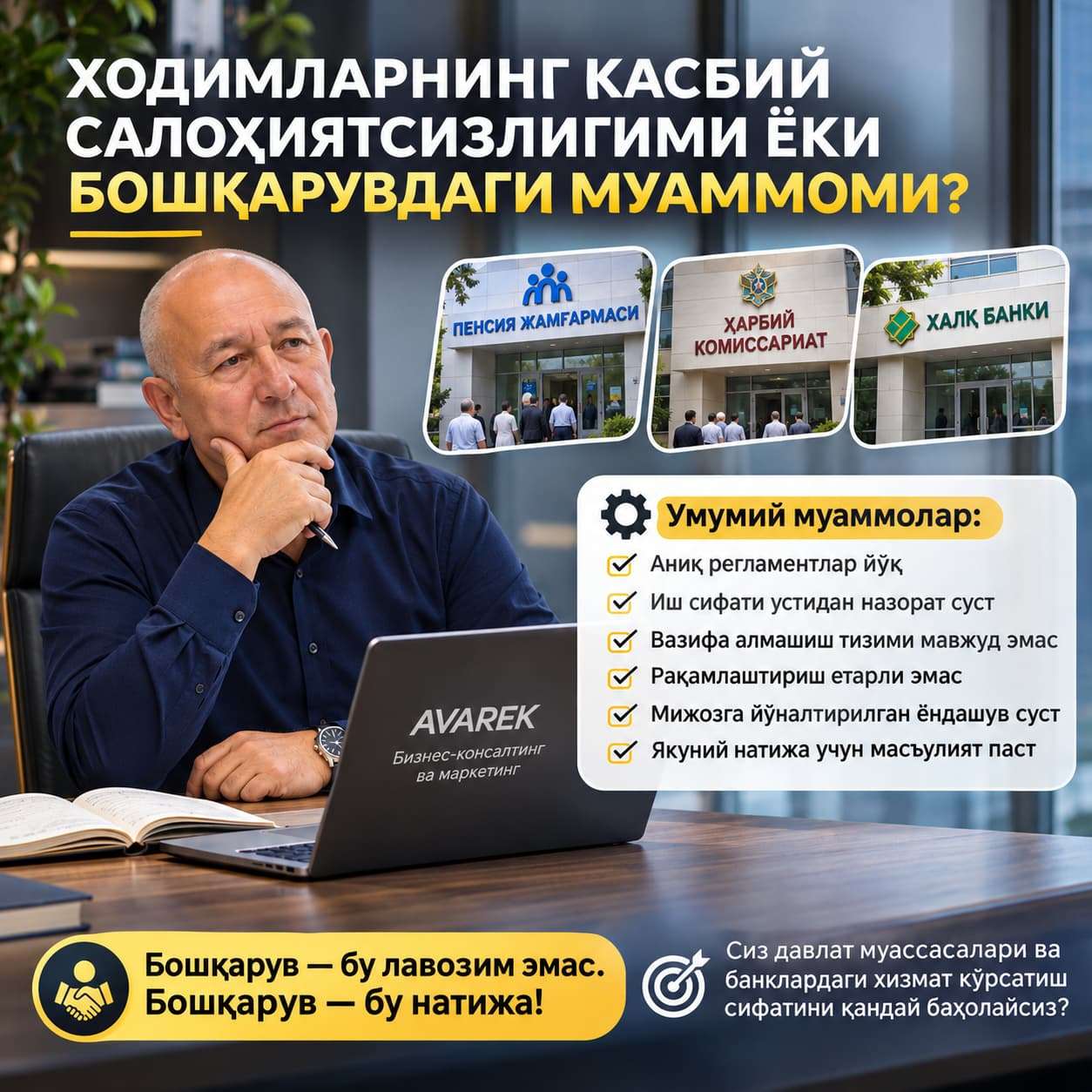
Employee Competence or Management Issue: Systemic Problems of Management and Service Quality
Why do the same problems recur in government institutions, banks, and commercial organizations? Is it really only due to the insufficient qualifications of the employees?
The efficiency of any organization is determined not only by the professional skills of the employees but also by how well the management system is set up. If internal processes are not properly organized, even an experienced specialist cannot provide high-quality service.
Recently, I encountered situations related to the activities of the Pension Fund, the military commissariat, and the People’s Bank. This experience prompted a broader analysis of the quality of management, employee competence, and the efficiency of organizational processes.
It should be noted that the following thoughts are based on personal experience and do not constitute a statistical study of the activities of all regional branches of these organizations.
1. Pension Fund: The Problem of Organizing Services for Citizens
One of the main indicators of the efficiency of a government institution is the quality and convenience of the services provided to the population.
However, in practice, several questions arise regarding the organization of work:
- Insufficiently clear advice on the list of necessary documents.
- Lack of consistent explanations about the next steps.
- Prolongation of waiting time due to internal meetings during citizen reception hours.
- Insufficient attention to the needs of citizens in work processes.
From a management perspective, these situations indicate the need to improve the customer service system, work regulations, and citizen reception processes.
Internal meetings, task distribution, and administrative processes should not negatively affect the quality of service to citizens.
2. Military Commissariat: Lack of Systematic and Consistent Processes
Serious questions arose during the interaction process with the military commissariat.
The main problem is the lack of a systematic approach in organizing work processes.
First is the inefficiency of the complaint review system.
It is not always clear who is responsible for a specific complaint, what stages need to be passed, and when the result can be expected.
Second is the problems related to archival data.
The absence or limited access to necessary information about former military personnel creates additional difficulties. Citizens are forced to search for documents independently, spending time and additional resources.
Third is the insufficient digitization of document circulation.
A significant part of interactions and document handling is still done in paper form. This complicates data processing, extends deadlines, and creates additional administrative barriers.
Fourth is the lack of a system for employee interchangeability.
If a responsible specialist is ill or on leave, some work processes may effectively stop.
This is a serious organizational shortcoming. No important process should depend solely on the presence of one employee at work.
Fifth is the lack of clear and transparent deadlines.
A citizen should know how their complaint is being processed, how long it will take to obtain a certificate, and who is responsible for fulfilling the request.
These issues require revisiting internal regulations, managing information, and properly distributing responsibilities.
3. People’s Bank: Service Quality as a Management Indicator
Bank activities are directly related to customer trust. Therefore, service quality should be one of the priority indicators of bank efficiency.
During my personal experience, the following questions arose regarding the organization of customer service:
- Employees not paying enough attention to visitors.
- More time being allocated to internal communication than to customer service.
- Insufficiently orderly organization of work processes.
- The need to strengthen control over service quality.
For a financial institution, this is especially important. A customer evaluates a bank not only by its financial products but also by the speed of problem-solving, the professionalism of employees, and the quality of communication.
4. General Issue: When Do Employee Shortcomings Become a Management System Problem?
Considering these three examples from a professional management perspective, several areas requiring special attention can be highlighted.
1. Lack of standardization of work processes.
Every employee should clearly know their duties, authorities, sequence of actions, and responsibility for results.
2. Insufficient personnel management system.
It is necessary to train employees, assess their competencies, control task execution, and establish mutual task interchangeability.
3. Low level of digitization.
A modern organization should use electronic document circulation, centralized databases, and automated systems for processing requests.
4. Lack of measurable efficiency indicators.
Employee performance should be evaluated not only by the formal completion of tasks but also by the quality and timeliness of the results.
5. Insufficient customer orientation.
The interests of citizens and customers should be an integral part of the management system. This should not depend solely on the personal attitude of a specific specialist.
5. What Management Solutions Are Needed?
In my opinion, a comprehensive approach is necessary to improve the efficiency of such organizations.
Main directions:
- Developing and implementing service standards.
- Describing and optimizing internal business processes.
- Implementing an electronic document circulation system.
- Creating a unified system for storing and searching information.
- Forming a system for mutual task interchangeability among employees.
- Implementing KPI and service quality indicators.
- Regularly assessing the professional competence of employees.
- Increasing the responsibility of department heads for the final result.
At the same time, it is important to understand that implementing KPI alone will not solve the problem. It is necessary to correctly set indicators, develop measurable standards, and impartially monitor their implementation.
6. Main Conclusion: Effective Management Starts with a Properly Organized System
Any government or commercial organization consists of interconnected processes, employees, resources, and management decisions.
If an organization’s activities are ensured only by certain responsible employees, it has not yet achieved the necessary level of management maturity.
The essence of professional management is to create conditions that ensure processes continue effectively even if a specific specialist is not at work, and to ensure that every employee clearly understands their responsibility.
Most importantly, a citizen or customer should not be involved in resolving the organization’s internal organizational issues.
A person’s time is considered a valuable resource, just like financial and material resources.
Management is not about having a position, office, or administrative authority. Management is the ability to effectively organize people and processes to achieve a specific result.
Improving the efficiency of any organization starts with this.
AVAREK expert approach: effective management, systematic management, business process optimization, and responsibility for results should become the foundation of modern organizational culture.